
By Mehluli Malisa Batakathi
Abstract
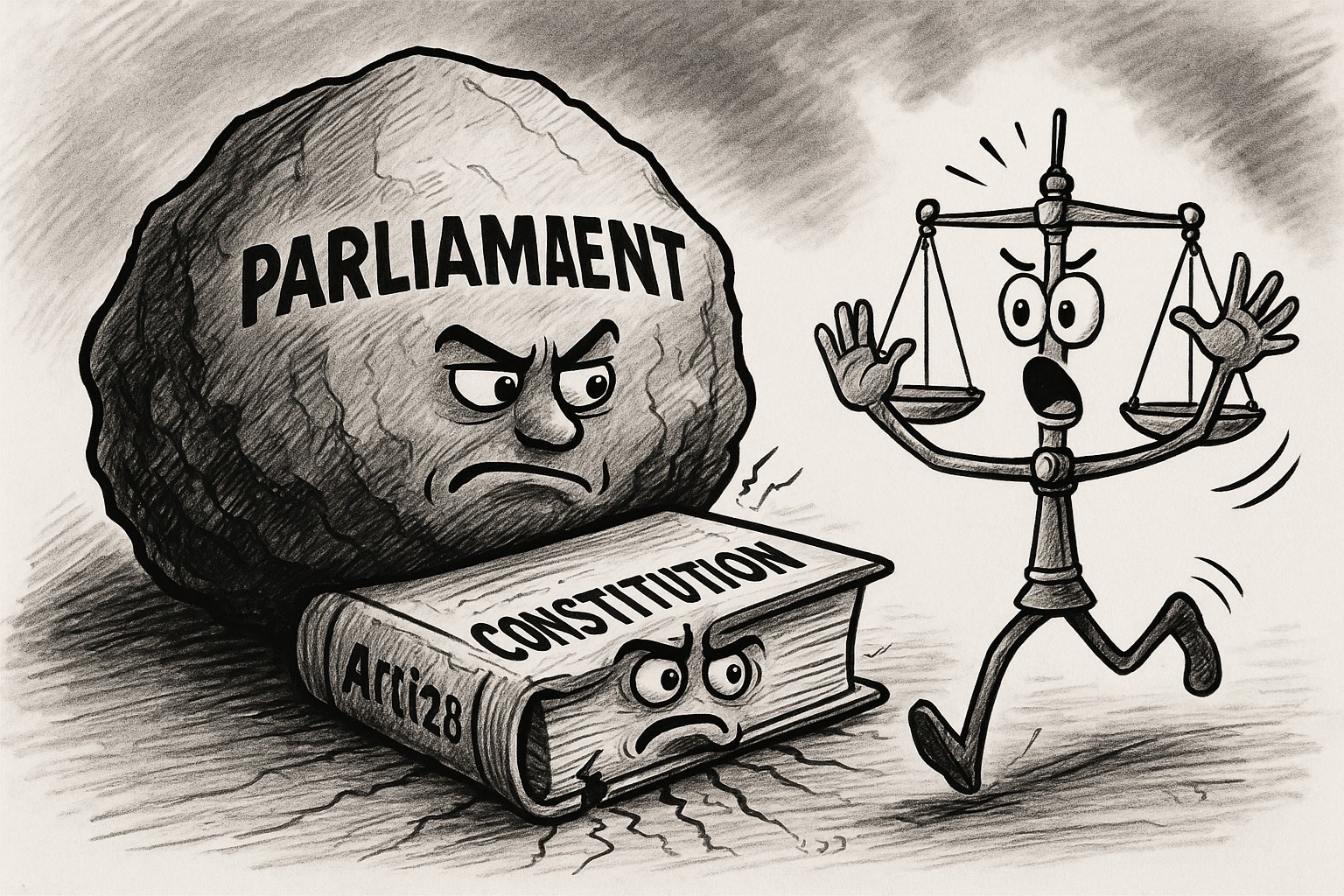
This paper critically examines the doctrine of exclusive cognisance in the context of Zambia’s evolving constitutional framework. Historically rooted in the British tradition of parliamentary sovereignty, the doctrine grants Parliament the exclusive authority to regulate its internal affairs without judicial interference. However, in jurisdictions such as Zambia, governed by a written and supreme Constitution, the continued application of this doctrine raises significant constitutional and normative concerns. This paper argues that the doctrine of exclusive cognisance cannot, and does not, extinguish the jurisdiction of the Constitutional Court to review and declare unconstitutional any acts or omissions of Parliament that are inconsistent with the Constitution. Drawing on Zambian case law and comparative jurisprudence from Kenya, South Africa, and India, the article explores the intersection of constitutional supremacy, parliamentary privilege, and judicial review. It demonstrates that in constitutional democracies, no organ of the state is above the Constitution, and judicial review of legislative conduct is not only permissible but imperative to uphold the rule of law, ensure accountability, and preserve the integrity of the constitutional order. The paper adopts a multidisciplinary approach, drawing from legal theory, constitutional design, political philosophy, and case law to advance a robust argument in favour of limiting the doctrine of exclusive cognisance in modern constitutional democracies
- Introduction
The question of how far parliamentary privilege can extend in a constitutional democracy is a contentious one. It lies at the intersection of constitutional supremacy, the rule of law, and the doctrine of separation of powers. Parliamentary privilege, particularly the doctrine of exclusive cognisance, confers on legislatures the right to regulate their internal affairs without external interference2. Yet, in jurisdictions with entrenched written constitutions, such as Zambia, the supremacy of the Constitution raises important questions about the validity and extent of such privilege.
Article 1(1) of the Constitution of Zambia3 provides unequivocally that the Constitution is the supreme law of the land and that any other written law, conduct or practice that is inconsistent with its provisions is void to the extent of the inconsistency. This constitutional declaration forms the cornerstone of Zambia’s governance architecture. The Constitution further provides, under Article 128(1)4, that the Constitutional Court has the exclusive
1 BSc. (HONS), LLB, LLM (Constitutional Law), Adjunct Lecturer, Copperbelt University
2 J Alder, Constitutional and Administrative Law 6th Edition, (Palgrave Macmillan 2008)
3 Constitution of Zambia (Amendment) Act No. 2 of 2016
4 Ibid
jurisdiction to interpret the Constitution and to determine the constitutionality of legislation and governmental conduct. These provisions establish a legal order in which no institution, not even Parliament, can operate beyond constitutional limits5.
It follows that, the doctrine of exclusive cognisance does not make Parliament immune from judicial scrutiny. Indeed, its continued unlimited invocation to shield unconstitutional legislative conduct from review by the judiciary poses a significant threat to the principles of constitutionalism and the rule of law. This paper interrogates the validity of exclusive cognisance within Zambia’s current constitutional context. It contends that where parliamentary conduct violates the Constitution, the Constitutional Court must exercise its oversight role to preserve democratic accountability and prevent the erosion of constitutional values.
In doing so, this paper adopts a comparative approach, drawing insights from other constitutional democracies that have grappled with similar tensions. The central thesis advanced is that exclusive cognisance is a subordinate doctrine within a constitutional framework premised on popular sovereignty and the supremacy of the Constitution. It may not be invoked to negate the Court’s interpretive and supervisory role, especially in the face of legislative overreach. - Historical Background of the Doctrine of Exclusive Cognisance
The doctrine of exclusive cognisance is historically rooted in the constitutional evolution of England. During the 17th century, Parliament sought to protect itself from the influence and intrusion of the Crown and the courts. This struggle culminated in the Glorious Revolution of 1688 and the enactment of the Bill of Rights of 1689, which codified various privileges of Parliament.6 Among them was the privilege that what is said or done in Parliament should not be questioned in any court or place outside Parliament. English jurist, William Blackstone, famously declared that the whole of the law on Parliament originates from one maxim:
‘‘That whatever matter arises concerning either house of parliament, ought to be examined, discussed, and adjudged in that house to which it relates, and not elsewhere’7
The doctrine was affirmed judicially through the speech of Lord Coleridge CJ in Bradlaugh v Gossett8, where he stated:
5 1(3) This Constitution shall bind all persons in Zambia, State organs and State Institutions.
6 J. R. Jones, “The Revolution in Context,” in Jones ed., Liberty Secured? Britain before and after 1688 , (Stanford: Stanford University Press, 1992.)
7 W. Blackstone, Commentaries on the Laws of England: Book I: Of the Rights of Persons (Oxford: Oxford University Press, 2016)
8 Bradlaugh v Gossett (1884) 12 QBD 271.
“What is said or done within the walls of Parliament cannot be inquired into in a court of law.”9
The case concerned the refusal of the House of Commons to allow Charles Bradlaugh to affirm his oath of allegiance, and the Court held that it had no jurisdiction to intervene in the internal procedures of Parliament. This decision laid the foundation for what would become known as the doctrine of ‘exclusive cognisance’, suggesting that each House of Parliament is the sole judge of the legality and propriety of its own proceedings.
It is noteworthy, however, that this doctrine was developed in the unique context of the British constitutional model, where Parliament is sovereign and not bound by a written, supreme Constitution.10 It is now widely understood that a written constitution which is respected, as it is in the United States of America, provides valuable safeguards which in Britain are somewhat lacking owing to parliamentary sovereignty.11 It is therefore contended that the transplantation of exclusive cognisance into jurisdictions like Zambia, which are governed by codified constitutions that explicitly limit the powers of all arms of government, must be done cautiously and contextually. Unlike in the United Kingdom, in Zambia, power flows from the Constitution, not from parliamentary traditions. The constitutional supremacy enshrined in Article 1(1)12 requires that all state institutions, including Parliament, are subject to judicial review where their conduct is inconsistent with the Constitution.
As such, the author posits that the doctrine of exclusive cognisance cannot be treated as an absolute bar to judicial scrutiny. To do so would be to elevate a common law privilege above the foundational norms of the constitutional order. The Zambian legal system, rooted in constitutional supremacy and committed to democratic accountability, must reject any absolutist interpretation of legislative privilege that erodes constitutional checks and balances. - The Zambian Constitutional Framework: Supremacy and Judicial Review
The Zambian constitutional framework, as currently structured under the Constitution of Zambia, 2016, is firmly founded on the doctrine of constitutional supremacy. Article 1(1) provides that:
9 Ibid at page 275
10 A.V. Dicey, Introduction to the Study of the Law of the Constitution (Macmillan 1959).
11 H.W.R. Wade and C. F. Forsyth, Administrative Law Eleventh Edition (Oxford: Oxford University Press, 2014)
12 Note 3, supra
‘This Constitution is the supreme law of the Republic of Zambia and any other written law, customary law and customary practice that is inconsistent with its provisions is void to the extent of the inconsistency.’13
Further, Article 1(3) declares that:
‘This Constitution shall bind all persons in Zambia, State organs and State Institutions.’14
These provisions fortify the position that in Zambia, the Constitution stands above all forms of law and governmental conduct. They embody the fundamental principle that all state institutions derive their power from the Constitution and are bound to exercise such power within constitutional limits. In this sense, the supremacy of the Constitution is not merely a symbolic provision, it is a substantive guarantee of legality, accountability, and the rule of law.
The Constitution further establishes the Constitutional Court under Article 127, which is vested with exclusive jurisdiction to interpret the Constitution, adjudicate disputes relating to the Constitution, and ensure that the actions of all state organs are consistent with constitutional norms. Article 128(1) provides:
‘Subject to Article 28, the Constitutional Court has original and final jurisdiction to hear— (a)a matter relating to the interpretation of this Constitution;
(b) a matter relating to the Constitution and the validity of any law or conduct under this Constitution…’
This establishes the Constitutional Court not only as the guardian of constitutional interpretation but as the ultimate arbiter in determining whether laws and actions, including those of Parliament, are constitutionally valid. This role is critical in maintaining the equilibrium of power among the branches of government and ensuring that no institution assumes immunity from accountability.
In a legal system governed by constitutional supremacy, like Zambia it is axiomatic that no doctrine, including that of exclusive cognisance, may operate in a manner that nullifies or attenuates the Constitutional Court’s jurisdiction. To hold otherwise would be to allow a common law privilege to override an express constitutional provision, thereby defeating the constitutional structure itself. It is against this background that the application of exclusive cognisance must be measured, and its limits judicially defined.
13 Ibid
14 Ibid - Zambian Jurisprudence on Legislative Accountability
The jurisprudence of the Constitutional Court of Zambia has progressively affirmed the supremacy of the Constitution over all state institutions, including the legislature. In Chishimba Kambwili v Attorney General15 the Constitutional Court acknowledged somewhat, the existence of the doctrine of exclusive cognisance by holding that the National Assembly had the exclusive power and jurisdiction over the conduct of its internal affairs. While the Court has not expressly ruled on the scope or extent of the doctrine, its decisions in related cases offer clear guidance on how parliamentary conduct is subject to judicial oversight.
In Law Association of Zambia and Chapter One Foundation v Attorney General16 the Court held that it is vested with jurisdiction over a challenge to a Parliamentary Bill if the issues related to compliance with the procedure of amending the Constitution as provided by Article 79 of the Constitution itself.
Citing the Supreme Court case of Godfrey Miyanda v The Attorney General17, the Constitutional Court stated:
“…this Court is not completely devoid of jurisdiction to intervene, as appropriate, when alterations to the Constitution offend the formal procedure set out for constitutional amendments.”
Essentially, the Constitutional Court laid down the rule that Courts could intervene in the legislative process if a procedure adopted when dealing with a proposed Bill infringed Constitutional parameters for amendment. This rule was applied in the recent case of Munir Zulu and Celestine Mukandila v Attorney General18, where the Constitutional Court considered a challenge to the constitutionality of the process leading up to the gazetting of Constitutional Amendment Bill No. 7 of 2025 and its presentation to the National Assembly. The Court held that the proposed amendment was invalid because it violated the procedural requirements for constitutional amendment, particularly that there had been no tangible public participation or stakeholder consultation in the formulation of the Bill. The Court observed:
“These provisions are not mere euphemisms but the direct instructions of the People, as the framers of the Constitution, to the State organs and to the State officers/constitutional functionaries that make them organic. They are all bound to the letter and spirit of the Constitution as provided in Article 1(3) of the Constitution. This means that the Legislature/Executive, are involved in the formal enactment of the Constitution in a limited capacity, as derivatives of the Constitution, given life by the
15 2019/CCZ/009
16 2019/CCZ/0013 and 2019/CCZ/0014
17 (1983) Z.R 78 SC
18 2025/CCZ/009
People. As Zambia is a constitutional democracy, the Executive and Legislature are always the agents of the People never the principal.19
The Court’s judgment underscores the ideal that legislative action, even in the exercise of constitutional amendment powers, must comply with the broader principles of constitutionalism, including transparency, public participation, and procedural integrity. It further emphasised that Article 128(3)(c) of the Constitution placed no limits on the Constitutional Court’s powers of review20 as such, the Court retains the power to review and invalidate any action of Parliament that violates constitutional mandates. These decisions collectively illustrate the Court’s commitment to ensuring that legislative conduct remains accountable to the Constitution. They represent a growing body of jurisprudence that limits the scope of legislative privilege and reinforces the principle that no institution may claim insulation from constitutional review. - Comparative Perspective on Legislative privilege: Kenya, South Africa, and India
Zambia is not alone in grappling with the question of how far parliamentary privilege may extend in a constitutional democracy. Judiciaries in other jurisdictions with similar constitutional frameworks have had occasion to examine the doctrine of exclusive cognisance in relation to constitutional supremacy. Comparative jurisprudence reveals a consistent trend in constitutional democracies: legislative privilege is not a licence for constitutional evasion. The experiences of Kenya, South Africa, and India are particularly instructive.
5.1 Kenya
In Kenya, the 2010 Constitution introduced a robust framework of constitutional supremacy, participatory democracy, and public accountability. In The Attorney General and Others v David Ndii and Others21, the Supreme Court of Kenya Court had to deal with the question of whether the courts had jurisdiction to adjudicate the constitutionality of a constitutional amendment Bill. The Respondents argued that exclusive cognisance enjoyed by Parliament barred the Court from intervening with a Bill. They claimed that the Court could only entertain a challenge only after the Bill had been passed into law.
On this particular issue, the Supreme Court affirmed that the doctrine separation of powers demands that the three organs of government must perform the functions constitutionally required of them therefore, the judiciary must not usurp the powers given to the Legislature or Executive. However, the Supreme Court nevertheless, held that the High Court and indeed the Supreme Court had jurisdiction to adjudicate over the Bill to amend the Constitution where the fundamental rights and entrenched provisions of the Constitution were
19 Ibid at page J17
20 Ibid, page J18
21 Petition No 12 Of 2021 (Consolidated Petition Nos. 11 & 13 Of 2021)
threatened, and where there was procedural impropriety.22 In casu, notably, the Supreme Court delved into the contents of the Bill and declared certain clauses unconstitutional but also declared the entire Bill unconstitutional on account that it did not conform to the right procedure of amending the constitution. This decision demonstrates that the judiciary can, and must, intervene where parliamentary conduct contravenes constitutional requirements, irrespective of claims to exclusive jurisdiction.
5.2 South Africa
South African jurisprudence has also addressed this issue. It is noteworthy that South Africa also operates under a written Constitution, which is supreme over all laws and state organs. Equally, the South African Parliament is accorded with immunity which is enjoyed by the members of Parliament over the things they say, and parliament as a body over the business it conducts which includes the passing of laws.23 Evidently, the South African Parliament also enjoys exclusive cognisance. However, in Doctors for Life International v Speaker of the National Assembly24, the Constitutional Court struck down four statutes because Parliament had failed to facilitate adequate public participation during the passage of the bills. The Court guided that all legislative authority is subject to the Constitution.
In Speaker of National Assembly V Patricia de Lille and Another25, Patricia de Lille challenged the Speaker’s decision to suspend her from Parliament. The paramount issue was whether or not the National Assembly had any lawful authority to take any steps to suspend Ms. Patricia de Lille from Parliament. The Speaker argued that parliamentary privilege clothed Parliament with exclusive cognisance over its internal affairs thereby immunising any parliamentary function from judicial review. The Court held in favour of Ms. Lille stating thus:
“…it follows that any citizen adversely affected by any decree, order or action of any official or body, which is not properly authorised by the Constitution is entitled to the protection of the Courts. No Parliament, no official and no institution is immune from Judicial scrutiny in such circumstances…”26
5.3 India
Perhaps the most decisive repudiation of the doctrine of exclusive cognisance comes from India. In Raja Ram Pal v. Honourable Speaker, Lok Sabha & Others27, the Indian Supreme Court confronted the constitutional boundaries of exclusive parliamentary cognisance under Article 122 of the Indian Constitution, which limits judicial scrutiny of parliamentary proceedings. The case arose when several Members of Parliament were expelled following a
22 Ibid
23 M Mathenjwa ‘The Constitutional Phenomenon of Parliamentary Privilege and Immunity in South Africa: A Comparison with Jurisdictions in Britain, Canada and France’ (2016) 49 Comparative and International Law Journal of Southern Africa
24 2006 (6) SA 416 (CC)
25 [1999] 4 SA 241 (A).
26 Ibid, page 5.
27 (2007)3 SCC 184
sting operation that exposed them accepting bribes for raising questions in Parliament. The expelled MPs challenged the decision, arguing that it violated their constitutional rights and was procedurally flawed. The Speaker, in defence, invoked exclusive cognisance, claiming the matter was internally regulated by Parliament and beyond judicial review.
The Supreme Court, however, held that while Parliament enjoys exclusive cognisance over its internal procedures, this privilege is not absolute and does not bar judicial review where a decision violates constitutional principles, including the rule of law, natural justice, or fundamental rights. The Court ruled that the expulsion was justiciable as it had civil consequences and needed to conform to the basic structure of the Constitution.
The Court further stated that Parliamentary privileges must align with constitutional values and cannot undermine fundamental rights or due process. The same principle was reiterated in Special Reference No. 1 of 1964 (Keshav Singh’s Case)28, where the Court ruled that legislative privileges do not override constitutional guarantees and may be subjected to judicial interpretation. The Court underscored that the powers of the legislatures in India should not be equated with the powers held by the House of Commons in the United Kingdom. Though the powers are similar in nature, the legislature in India was subject to Constitutional provisions and that the Constitutional supremacy in India must be acknowledged. All organs of government should function in conformation with the constitution.29
Collectively, these cases above reflect an emerging consensus in comparative constitutional jurisprudence. They affirm that while parliaments must retain some autonomy to function effectively, such autonomy is circumscribed by the constitutional order; the doctrine of exclusive cognisance cannot operate as an absolute bar to judicial review in a system governed by a supreme Constitution. Privileges must yield where their exercise threatens to violate constitutional rights, principles, or procedures. In the circumstances, Judicial review acts not as an encroachment, but as a safeguard against institutional excess. - Philosophical Foundations: Constitutionalism and the Limits of Legislative Autonomy
To properly appreciate the tension between exclusive cognisance and the powers of the courts, one must engage the philosophical underpinnings of constitutionalism. The theoretical justification for exclusive cognisance is rooted in the doctrine of separation of powers and the institutional need for Parliament to operate free from judicial or executive interference. However, modern constitutional theory necessitates a reassessment of the boundaries of this privilege.
Constitutionalism posits that government is not merely a mechanism for collective decision-making, but a moral and legal enterprise grounded in the rule of law, accountability, and
28 Keshav Singh v Speaker Legislative Assembly and Others AIR 1965 SC 745
29 Ibid
separation of powers. As Lon Fuller argues, law’s internal morality demands that rules be general, public, prospective, and consistent30. These attributes are undermined when any institution is allowed to insulate itself from legal accountability and claims unchecked authority.
A.V. Dicey’s doctrine of parliamentary sovereignty, which forms the traditional justification for exclusive cognisance, and often invoked to support parliamentary supremacy, suggests that Parliament may legislate on any matter and is not legally bound by prior enactments.31 This is incompatible with the modern idea of constitutional supremacy. In constitutional systems where power flows from the people and is constrained by a written constitution such as in Zambia, Diceyan Parliamentary sovereignty becomes obsolete. Instead, the Constitution becomes the ultimate authority, and all privileges or immunities must be read as subordinate to its dictates.
Ronald Dworkin, in Law’s Empire, makes a compelling case for interpretive fidelity to constitutional principles that are morally sound and socially just. According to Dworkin, legal interpretation must align with the values of fairness, equality, and accountability.32 When viewed through this lens, exclusive cognisance cannot be absolute. It must be conditioned by the broader constitutional values that legitimise institutional power. If parliamentary conduct escapes judicial scrutiny under the guise of privilege, then the very architecture of constitutional governance is at risk.
The author contends that the idea that Parliament should be the sole judge of its own proceedings also conflicts with the ancient maxim ‘nemo iudex in causa sua’, which simply means no one should be a judge in their own cause. To allow Parliament to determine the constitutionality of its own actions without judicial oversight is to sanction impunity and erode the rule of law. Judicial review, far from being a threat to legislative independence, is a necessary counterbalance in a system that distributes power with checks and accountability mechanisms.
In this regard, exclusive cognisance is better understood, not as a categorical bar to judicial review, but as a functional doctrine that must be interpreted in harmony with constitutionalism. It is neither absolute nor sacrosanct. Its application must always yield to constitutional fidelity and the demands of justice. - Conclusion
The doctrine of exclusive cognisance, though historically anchored in the pursuit of institutional independence, must be reconciled with the demands of constitutional supremacy, though historically significant and constitutionally relevant, it must not be
30 L. Fuller, The Morality of Law (Yale University Press 1969).
31 A.V. Dicey, Introduction to the Study of the Law of the Constitution (Macmillan, 1959)
32 R. Dworkin, Law’s Empire (Harvard University Press, 1986).
interpreted in a manner that subverts the foundational principles of constitutional supremacy, accountability and the rule of law. In Zambia, the Constitution stands as the supreme legal authority, and its provisions cannot be ousted by customary doctrines rooted in parliamentary sovereignty. As this article demonstrated, in the Zambian context and further reinforced through comparative jurisprudence, no doctrine or privilege can oust the jurisdiction of the Courts to review the actions of Parliament for conformity with the Constitution.
In Zambia, the constitutional provisions under Articles 1(1), 1(3), 127, and 128 clearly establish that all state institutions, including the National Assembly, are subordinate to the Constitution. Legislative autonomy is vital for institutional independence, but it must be exercised within the bounds of constitutional legality. The judiciary’s role is not to interfere in the ordinary proceedings of Parliament but to ensure that its conduct does not breach constitutional safeguards, particularly those relating to rights, procedural justice, and public accountability. Drawing lessons from jurisdictions such as Kenya, South Africa, and India, this article has demonstrated that the use of exclusive cognisance to resist judicial scrutiny is both doctrinally untenable and jurisprudentially unsustainable. The author takes the view that legislative privilege is not a shield against constitutional accountability. The courts in Kenya, South Africa, and India have offered a persuasive jurisprudential model by drawing a clear boundary between legitimate parliamentary autonomy and unconstitutional conduct. Zambia’s jurisprudence, particularly in the Munir Zulu case, is beginning to tread a similar path.
A recalibration of the application of the doctrine of exclusive cognisance is urgently required. Parliament should revise the National Assembly (Powers and Privileges) Act to expressly exclude its application where constitutional rights or processes are in question. The judiciary must continue to affirm its role as the guardian of the Constitution, and civil society should remain vigilant in holding all branches of government to account. Ultimately, exclusive cognisance cannot be a doctrine of constitutional exemption. Any form of legislative privilege must serve the Constitution, not subvert it. It must facilitate legislative independence, not legislative impunity and must be interpreted as a procedural safeguard that protects parliamentary processes from undue interference, but not from judicial scrutiny where constitutional infractions are alleged. This recalibration of the doctrine will uphold the Constitution as the supreme law and preserve the delicate balance between institutional independence and constitutional accountability.

Leave a Reply